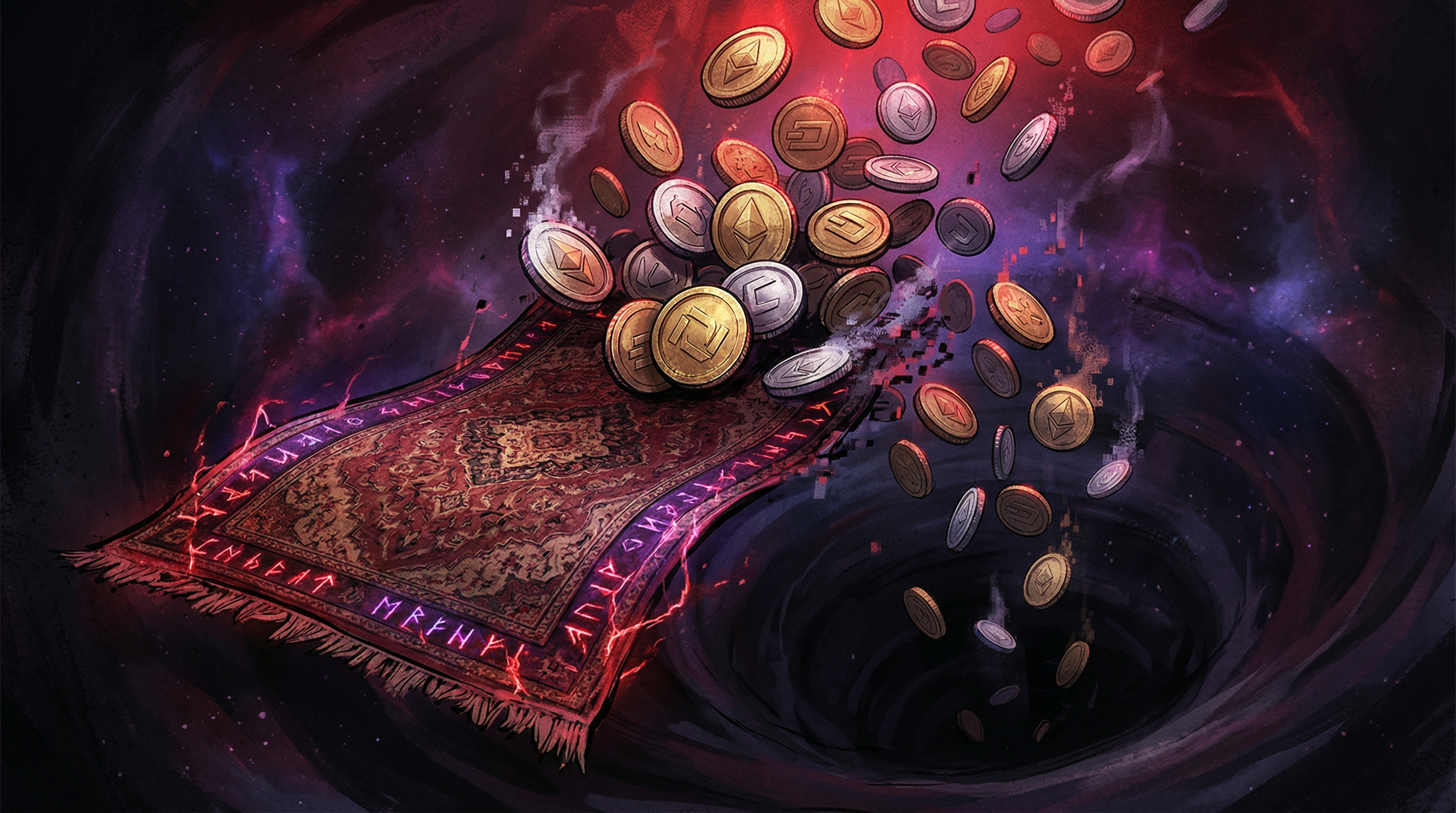
If you've spent more than 48 hours in crypto, you've heard the term. Someone got "rugged." A project "pulled the rug." The devs "did a rug." But what actually happens during a rug pull, and why do people keep falling for them?
Let's break it down — no sugar coating, no jargon walls. Just the raw mechanics of how degens get separated from their money.
What Is a Rug Pull, Exactly?
A rug pull is when the creators of a crypto project — usually a token or DeFi protocol — suddenly drain the liquidity or abandon the project, leaving investors holding worthless tokens. Think of it like a store that takes everyone's money, then vanishes overnight with the shelves empty and the doors locked.
There are three main flavors:
- Liquidity theft: Devs create a token, pair it with ETH or SOL in a liquidity pool, wait for buyers to flood in, then withdraw all the liquidity. Your tokens are now worth exactly zero.
- Sell-wall manipulation: The smart contract is coded so that only the devs can sell. You can buy in, but you literally cannot sell. It's a roach motel for your money.
- Slow rugs: The team gradually dumps their massive token allocation over weeks or months while pretending to still be "building." By the time the community notices, it's too late.
Real Examples That Cost Real Money
The history of crypto is littered with rug pulls, from the small-time to the catastrophic. The Squid Game token in 2021 spiked to $2,861 before crashing to near-zero in seconds — the devs walked away with an estimated $3.4 million. OneCoin, while technically a Ponzi scheme, operated on similar principles and defrauded investors of over $4 billion worldwide. And countless micro-cap tokens on Solana and Base chains get rugged daily without even making headlines.
The most successful traders combine knowledge with the right tools. Focus on understanding the fundamentals before committing real capital.
Red Flags: How to Spot a Rug Pull Before It Happens
Not every rug pull is obvious, but many share common patterns. Here's your checklist:
- Anonymous team with no track record. Anonymity is fine in crypto, but if the team has zero verifiable history and no reputation to protect, your risk goes up exponentially.
- Liquidity isn't locked. If the LP tokens aren't locked or burned, the devs can pull them anytime. Check the contract on a block explorer.
- No audit. A professional smart contract audit isn't a guarantee of safety, but the absence of one is a massive red flag.
- Hype over substance. If the project's entire marketing strategy is "number go up" and influencer shills, with no whitepaper, no roadmap, and no working product — run.
- Concentrated token supply. If the top wallets hold 50%+ of the supply, one sell order can nuke the price to zero.
- Too-good-to-be-true APYs. 10,000% APY isn't a yield strategy. It's a ticking time bomb with a green number on it.
Why People Keep Getting Rugged
Here's the uncomfortable truth: most people who get rugged know the risk. They're not ignorant — they're gambling. The allure of a 100x on a microcap token is powerful enough to override every rational warning sign. It's the same psychology that keeps casinos profitable.
FOMO is a hell of a drug. When you see a token pumping 500% in an hour and your timeline is full of screenshots of six-figure gains, the logical part of your brain gets real quiet. The degen part starts whispering, "just a small bag, what's the worst that could happen?"
The worst that can happen is exactly what rug pulls are designed to make happen. You lose everything you put in.
How to Protect Yourself
Do your own research. Not "I saw three people tweet about it" research. Actual research. Read the contract. Check the liquidity. Look at the token distribution. Use tools like RugCheck, TokenSniffer, or DEXScreener to analyze tokens before you ape in.
Never invest more than you can afford to lose. This isn't just a disclaimer — it's a survival strategy. If a rug pull on a memecoin would actually hurt your finances, you're playing a game you can't afford to play.
Trust actions, not words. Locked liquidity, burned tokens, transparent team, working product, third-party audits. These are actions. Discord hype, Twitter influencers, and Telegram pump groups are just words.
The Bottom Line
Rug pulls aren't going away. As long as there's money to be made and low barriers to launching tokens, scammers will keep building traps. Your best defense isn't cynicism — it's education. Understand the mechanics, recognize the patterns, and make informed decisions about where your money goes.
Stay sharp out there, anon. The blockchain never forgets, but it also never forgives.
Trade smarter, not harder
Traderise gives you the tools to research, analyze, and execute — all in one place. No commission on your first 10 trades.
Try Traderise Free →