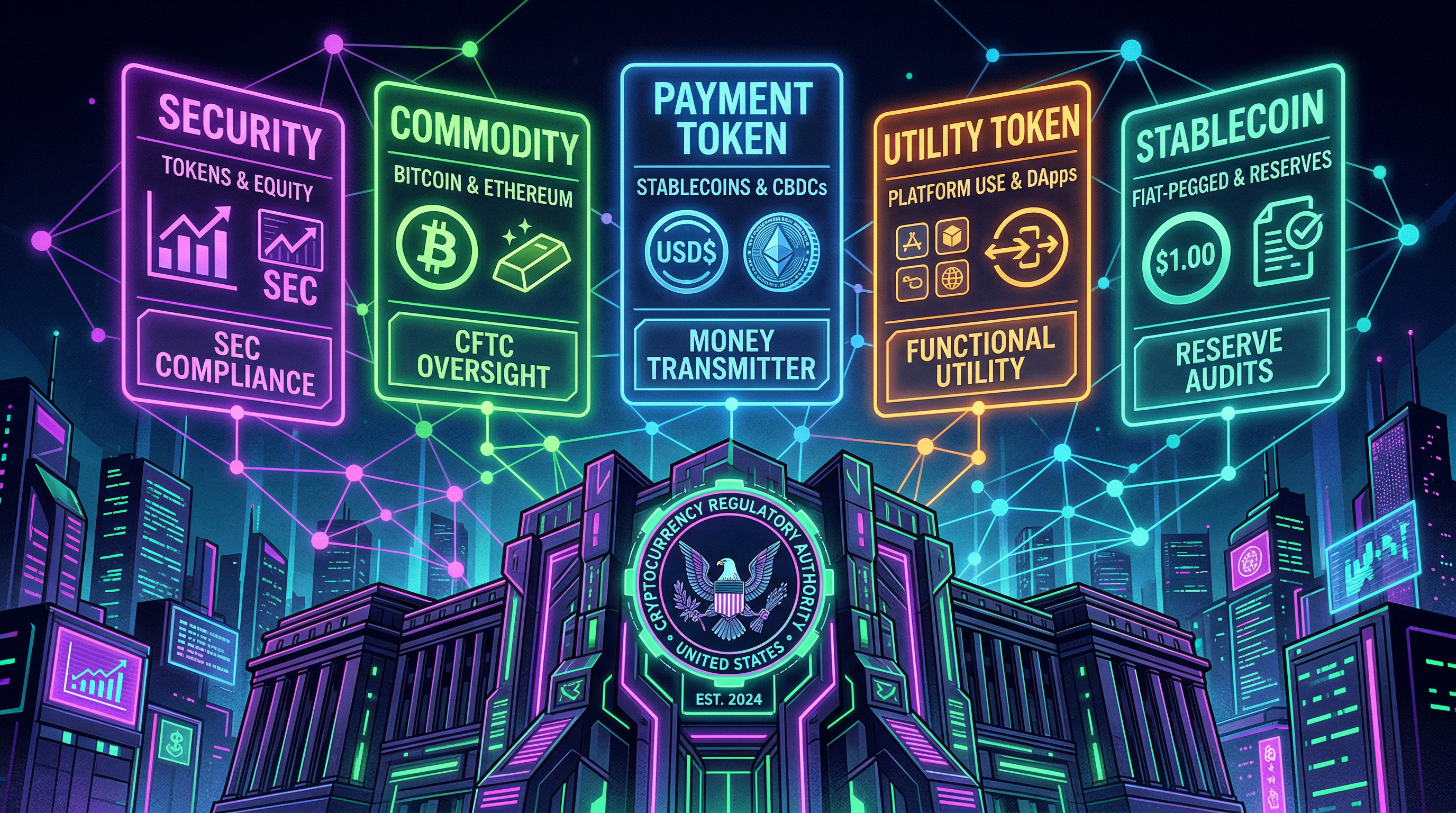
On March 17, 2026, the SEC dropped what might be the most consequential crypto document since the Howey test: a commission-level interpretive release that sorts every cryptoasset on the planet into five neat categories — and finally tells you which ones are securities and which ones aren't.
If that sounds boring, it's not. This single document just gave BTC, ETH, SOL, and a dozen other L1 tokens an official "not a security" stamp. It greenlit staking. It defined stablecoins. And it created a roadmap for tokens sold via investment contracts to eventually trade freely on secondary markets. For anyone holding crypto, trading crypto, or building on crypto, this changes the game.
Let's decode it.
Why This Interpretation Matters (and Why Now)
For years, the SEC's stance on crypto was basically "come at me and find out." They sued Ripple, went after Coinbase, and repeatedly refused to say which tokens — besides Bitcoin — were not securities. The entire industry operated in legal fog.
This interpretive release blows the fog away. It supersedes all prior staff guidance and creates a formal, commission-level framework. Not a suggestion. Not a speech at a conference. A binding interpretation that SEC enforcement has to follow.
The timing isn't random either. With the GENIUS Act working through Congress and bipartisan momentum for crypto legislation, the SEC is essentially drawing its regulatory lines before lawmakers draw them instead.
This is a commission-level interpretation — not staff guidance that can be quietly walked back. It's the SEC's official position on how securities laws apply to crypto. Every enforcement action and no-action letter going forward has to align with this framework.
The Five-Part Taxonomy: Every Crypto Now Has a Label
The heart of the release is a classification system that puts every cryptoasset into one of five buckets. Here's the breakdown — in degen, not legalese:
1. Digital Commodities
What they are: Tokens that derive value from being part of a functional, decentralized cryptosystem. Their price comes from supply and demand, not from someone's managerial hustle behind the scenes. No central party controls participation or distributes rewards.
Named examples: Bitcoin (BTC), Ethereum (ETH), Solana (SOL), XRP, Cardano (ADA), Aptos (APT), Avalanche (AVAX), Chainlink (LINK), and even Dogecoin (DOGE).
Are they securities? No. The SEC explicitly says these tokens are not securities. They might be "commodities" under the Commodity Exchange Act (hello, CFTC jurisdiction), but they're not going to get you sued by the SEC for trading them.
This is massive. For years, ETH's status was ambiguous. SOL was in even murkier waters. Now they're officially in the clear.
2. Digital Collectibles
What they are: Tokens designed to be collected or enjoyed — art, music, in-game items, memes, trading cards. Value comes from cultural significance and market demand, not from post-sale managerial effort.
Key nuance: Creator royalties alone don't turn a collectible into a security. But fractionalization might raise securities issues (looking at you, NFT-fi platforms). And here's a wild one: a meme coin can start as a digital collectible and evolve into a digital commodity if it becomes functional within a cryptosystem.
Are they securities? Not inherently. But the pathway from collectible to commodity to "wait, this might be an investment contract" is something to watch.
3. Digital Tools
What they are: Tokens with a practical function — memberships, event tickets, credentials, identity badges. Value comes from utility, not financial rights. Many are non-transferable or "soulbound."
Are they securities? No. The SEC sees these as purely functional.
4. Stablecoins
What they are: The interpretation covers "Covered Stablecoins" — tokens designed to maintain a 1:1 peg with the US dollar, backed by low-risk liquid reserves, and redeemable at par. This includes stablecoins under the GENIUS Act framework.
Are they securities? Covered Stablecoins are not. But the SEC left the door open: stablecoins outside this definition — algorithmic stablecoins, yield-bearing stablecoins, and exotic peg mechanisms — might still be securities depending on the facts.
Translation: USDC and USDT (assuming reserve compliance) are fine. That 20% APY "stablecoin" you found on a random DEX? Proceed with extreme caution.
5. Digital Securities
What they are: Financial instruments that are already securities under existing law but happen to be represented onchain. Tokenized stocks, bonds, fund shares — the wrapper doesn't change the classification.
Are they securities? Yes. Always. "A security is a security regardless of whether it is issued offchain or onchain." No ambiguity here.
If you're trading tokenized versions of Apple stock on some protocol, you're trading securities. Full stop. That means all the usual rules — registration, disclosure, broker-dealer requirements — apply.
Trade crypto with regulatory clarity
Traderise gives you access to crypto, stocks, and forex in one regulated platform — no guessing which assets are compliant. Start trading with confidence.
Try Traderise Free →Staking Gets the Green Light (With Fine Print)
One of the biggest wins in this release: the SEC formally said that protocol staking on proof-of-stake networks does not involve securities transactions. This covers:
- Self-staking — running your own validator
- Custodial staking — delegating to a third party
- Liquid staking — getting receipt tokens (like stETH, rETH) for your staked assets
The logic: node operators perform "administrative or ministerial" tasks. You're not relying on someone's "essential managerial efforts" to generate profits — you're participating in consensus. The Howey test doesn't apply.
Staking receipt tokens (stETH, rETH, etc.) are also not securities, as long as the underlying asset isn't a security. This is a huge deal for DeFi composability — it means the entire liquid staking ecosystem can operate without worrying about securities registration.
The fine print: This only applies when the staking provider's role stays ministerial. If a provider exercises discretion over how much to stake, guarantees fixed rewards, or offers yield-enhancing services beyond basic validation, those arrangements might fall outside this safe harbor.
Restaking: The SEC's Biggest "No Comment"
Here's where it gets spicy. The SEC explicitly excluded restaking from its interpretation. EigenLayer, Symbiotic, Karak — all of the restaking infrastructure that's attracted billions in TVL — sits in regulatory limbo.
The release doesn't say restaking is a security. It doesn't say it isn't. It just… punts. And in SEC language, a deliberate exclusion from a safe harbor is not exactly a warm hug.
Why Restaking Is Legally Complicated
Restaking takes your staked ETH and uses it as collateral for additional protocols (AVSes — Actively Validated Services). You're essentially lending your economic security to multiple networks simultaneously. The SEC probably sees this as more than "ministerial" because:
- Operators make discretionary decisions about which AVSes to opt into
- Reward structures are more complex (points, airdrops, variable yields)
- The risk profile is fundamentally different from simple staking
The Slashing Contagion Problem
Beyond the legal uncertainty, restaking carries real technical risk that the SEC may have been side-eyeing. When a validator restakes across multiple AVSes, a single slashing event on one AVS can cascade across all of them. Your collateral is shared — if one AVS slashes you (due to a bug, misconfiguration, or operational error), you lose withdrawal ability across every protocol you've opted into, including base Ethereum staking.
As security researchers at Cubist have documented, the risk scales with the number and complexity of AVSes. More services = more surface area for mistakes. Operational errors (migrating validators between machines), client bugs (remember the Prysm key deletion bug in 2023?), and even insider threats can trigger cascading slashing events. Most AVSes initially offer only one client implementation, amplifying the blast radius of any single vulnerability.
This isn't theoretical FUD — it's the structural reality of shared collateral systems. And it's probably part of why the SEC decided this was too complex to rule on alongside simpler staking arrangements.
If you're restaking, understand the risk: one bad AVS can take down your entire restaked position. Diversify across AVSes cautiously, use operators with anti-slashing infrastructure, and never restake more ETH than you can afford to have locked up indefinitely. The regulatory clarity you want doesn't exist yet.
The "Separation" Doctrine: When Investment Contracts Stop Mattering
Here's one of the most innovative (and underappreciated) parts of the release: the SEC introduced a concept of "separation" between a cryptoasset and the investment contract it was originally sold under.
Translation: even if a token was sold in an ICO or SAFT that constituted a securities offering, the token itself can eventually "separate" from that investment contract and trade freely — no securities registration needed.
When does separation happen? The SEC gave non-exclusive factors:
- The issuer fulfilled the promises made during the initial offering
- Enough time has passed that buyers no longer reasonably expect the issuer's ongoing efforts to drive value
- The issuer publicly abandoned further development or transferred control to a DAO/community
This is the SEC telling the world: "Yes, the initial sale was a security transaction. But the token can grow up and leave home." For projects that launched via SAFTs in 2017-2021 and are now fully decentralized, this provides a clear legal pathway to secondary market trading without SEC registration.
For traders on platforms like Traderise, this means the universe of legally tradeable tokens just got larger and clearer. Platforms can list these "separated" assets with more confidence.
What This Means for Your Crypto Strategy
Okay, enough legal analysis. What do you actually do with this information?
If You're Holding BTC, ETH, or Major L1s
Breathe. You're officially holding non-securities. This opens the door to more institutional products, ETFs, and regulated trading venues. It reduces the risk that your exchange suddenly delists your favorite asset because of SEC pressure. The regulatory ceiling just got higher.
If You're Staking
You're in the clear — as long as you're using straightforward staking providers. Liquid staking protocols like Lido and Rocket Pool are explicitly covered. Enjoy your yield. But if your staking arrangement involves guaranteed returns, discretionary management, or anything that sounds too good to be true, double-check that it fits within the interpretation's safe harbor.
If You're Restaking on EigenLayer or Similar
You're operating in a gray zone — both legally and technically. The SEC hasn't blessed it, the slashing risks are real, and there's no safe harbor to point to if something goes wrong. This doesn't mean you should panic-unstake. But it does mean you should size your restaking positions conservatively and stay current on both the regulatory and technical developments.
If You're Trading Stablecoins
USDC, USDT (assuming compliant reserves), and future GENIUS Act stablecoins are safe. But any stablecoin offering yield, exotic peg mechanisms, or algorithmic stabilization should be treated with skepticism — the SEC left the door wide open to classify those as securities.
If You're Trading NFTs or Memecoins
NFTs are "digital collectibles" and not inherently securities. But fractionalized NFTs could trigger securities laws. Memecoins are interesting: they start as collectibles but could become digital commodities if they gain real network utility. For now, trading them on a reliable platform like Traderise keeps you on the right side of compliance.
What's Still Unclear (The Fine Print Nobody Reads)
The interpretation is landmark, but it's not exhaustive. Several big questions remain:
- Restaking: Completely unaddressed. Expect future guidance or enforcement actions to define the boundaries.
- Yield-bearing stablecoins: Stablecoins that offer interest/rewards are in a gray area. The interpretation only covers "payment" stablecoins.
- AI tokens and DePIN: The taxonomy doesn't explicitly address tokens powering AI networks (like Bittensor, Render) or physical infrastructure. They might be digital commodities, tools, or something new entirely.
- Cross-chain assets: Wrapped tokens of non-securities are not securities. But what about bridged assets where the bridge operator has custody? TBD.
- Antifraud liability: Even after "separation," issuers can still be sued for material misstatements made during the original offering. Past sins don't get washed away.
The Bigger Picture: Regulation Is Becoming Constructive
Step back from the legal details and look at the trajectory. Two years ago, the SEC was suing exchanges and calling everything a security. Today, they're publishing detailed frameworks that explicitly carve out safe harbors for the most popular crypto activities. That's progress.
The GENIUS Act for stablecoins, the CLARITY Act for broader crypto markets, and now this interpretive release — they're building a regulatory stack that, for the first time, doesn't treat all of crypto as a fraud waiting to happen. It's not perfect. Restaking is still in limbo. DeFi governance tokens are still ambiguous. But the direction is unmistakably forward.
For Gen Z traders who grew up being told crypto was either the future or a scam, this is the moment the system starts to formalize. The adults are (finally) building rules that make sense. And that's good for everyone — even the degens.
Ready to trade in the new regulatory era?
Traderise combines crypto, stocks, and forex with built-in compliance tools and real-time analytics. Trade the assets you understand, on a platform built for the next generation.
Start Trading on Traderise →